Bachelor's Degree in Early Childhood Education: Paths, Licensure, and Pay

See if you qualify for Early Childhood Education programs
Answer a few questions in 2 minutes. Free, no commitment.
Bachelor's Degree in Early Childhood Education: Paths, Licensure, and Pay
A bachelor's degree in early childhood education prepares you to teach and care for children from birth through age 8, and a typical program runs about 120 credits, or four years of full-time study. Where you plan to work shapes which version you should pick. A public pre-K or kindergarten classroom calls for a licensure-track program and a state license, while Head Start sets its own degree rules and many child care centers hire with an associate degree or a state credential.
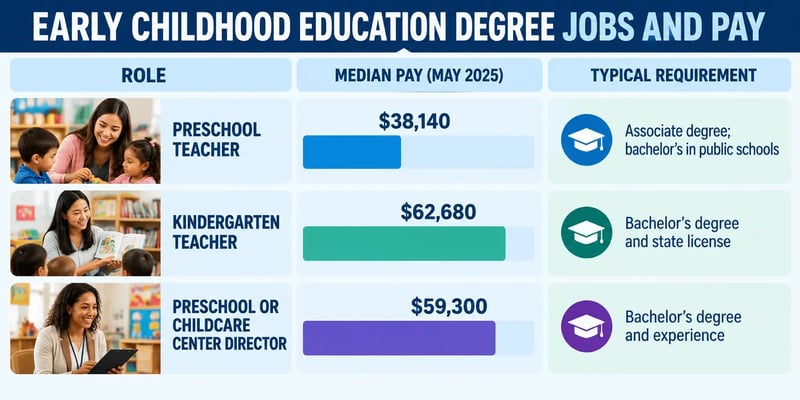
Pay follows the same split. Preschool teachers earned a May 2025 median of $38,140 overall, according to the Bureau of Labor Statistics (BLS), but those working in schools earned $52,800, compared with $36,850 in child daycare services.
Paying for the Degree
Start with the Free Application for Federal Student Aid (FAFSA), which schools use to award federal grants, loans, and work-study. If you're on a licensure track, also check whether your school participates in the federal TEACH Grant program, which pays up to $4,000 a year to students preparing to teach. Eligibility depends partly on grades, generally a cumulative GPA of at least 3.25 or a college admissions test score above the 75th percentile.
The grant comes with a service requirement. You must agree to teach full time for four elementary or secondary school years at a school serving low-income students, in a high-need field such as special education, bilingual education, or English language acquisition, and finish that service within eight years of leaving school. If you don't complete it, every TEACH Grant you received converts to a Direct Unsubsidized Loan, with interest charged from the date each grant was paid out.
Online Early Childhood Education Degree Programs on Dreambound
Online coursework makes this degree workable around a job, as long as you can complete field hours where you live. One website to consider is Dreambound, where you can compare online Early Childhood Education programs from accredited schools side by side.
Dreambound partners with accredited schools to list online Early Childhood Education degree programs you can fit around work and family.
If you want a shorter credential first, you can also compare the cheapest and fastest early childhood education programs before committing to four years. Some of the schools and programs listed on Dreambound include:
Liberty University Online
Program:
- B.S. in Education (Non-Licensure): Elementary Education Interdisciplinary Studies
- B.S. in Education (Non-Licensure): Special Education Interdisciplinary Studies
- B.S. in Education (Non-Licensure): Early Childhood Education Interdisciplinary Studies
- B.Ed. in Elementary Education
- B.Ed. in Elementary Education: Special Education General Curriculum K-6 Add-On
- 8-week classes
- Transfer in up to 75% of an undergraduate degree
- Accredited
As a nonprofit, Liberty strives to keep costs low for students.
Colorado Christian University
Program:
Both B.A. options are offered online. The first is the licensure track described earlier, and the second is the non-licensure track, which skips student teaching and includes 160 clock hours of field experience.
Arizona State University
Program:
ASU offers this program online, and its Dreambound listing does not describe it as a licensure program.
Is a Bachelor's in Early Childhood Education Worth It?
It's worth it when the job you want requires the degree or pays more because of it. The comparison below can help you decide.
It's likely worth it if you... | Think twice if you... |
|---|---|
Want a public pre-K, kindergarten, or early grades classroom | Plan to stay in a child care center role that hires with an associate degree |
Want to lead a center or teach in Head Start | Need to start working soon, when a CDA could get you in faster |
Want the higher pay of school settings ($52,800 median for preschool teachers) | Expect to stay in child daycare, where the median is $36,850 |
The work itself is demanding, with long, tiring days alongside young, active children and real responsibility for their safety. For people who want a career in early learning, though, the degree is the credential that licensed teaching and most director roles call for.
Frequently Asked Questions
What is the best degree for early childhood education?
No single degree fits every early childhood career. A licensure-track bachelor's in early childhood education fits public school pre-K through third grade, while a non-licensure bachelor's fits private preschools, Head Start, and center leadership.
What is the highest paying job in early childhood education?
Of the roles BLS tracks for this field, kindergarten teachers had the highest May 2025 median at $62,680, followed by preschool and childcare center directors at $59,300. Kindergarten teaching in public schools requires a state license.
What can you do with an early childhood education degree?
You can teach preschool, Head Start, or, with a license, kindergarten and the early grades. You can also direct a child care center or move into early intervention, curriculum development, or childcare licensing work.
What is the difference between early childhood and elementary education?
Early childhood education covers birth through age 8, with a focus on social, emotional, and cognitive foundations. Elementary education usually covers kindergarten through sixth grade and leans more heavily on subject teaching such as math, science, and language arts.
Planning Your Early Childhood Education Degree
Picture the classroom you want to be in five years from now. If it is a public school kindergarten, a licensure track belongs at the top of your list. If it is a Head Start room or a director's office, a non-licensure program can get you there with fewer hurdles, and a CDA can keep you working in the meantime.
When you're ready to compare schools, start with the online early childhood education programs listed on Dreambound and note which ones match the track you chose above.
For a closer look at the day-to-day job and how long the full path takes, these guides pick up where this one leaves off: