Key Points
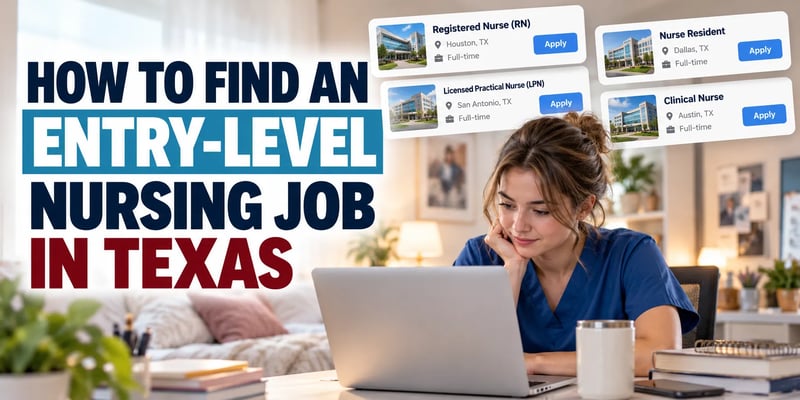
- 65.7% of early-career Texas nurses were offered a nurse residency, so the residency calendar drives most first-job searches (Texas Center for Nursing Workforce Studies, 2025).
- A Texas GN permit lets you work under direct RN supervision for up to 75 days while you wait to test, and it cannot be extended.
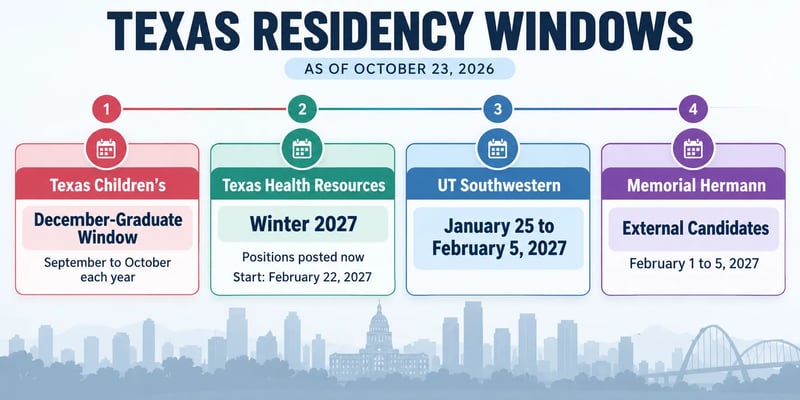
- Residency experience limits run from under 6 months to under 1 year, and application windows can be as short as five days.
- Texas RNs earn a median of $95,970 a year, and the lowest-paid 10% earn less than $67,120, the best public guide to starting pay (BLS, May 2025).
- Texas hospitals reported a 16.4% RN vacancy rate in 2024, so demand is there for graduates who apply on time.

Step 1: Choose Between a Nurse Residency and a Direct Hire
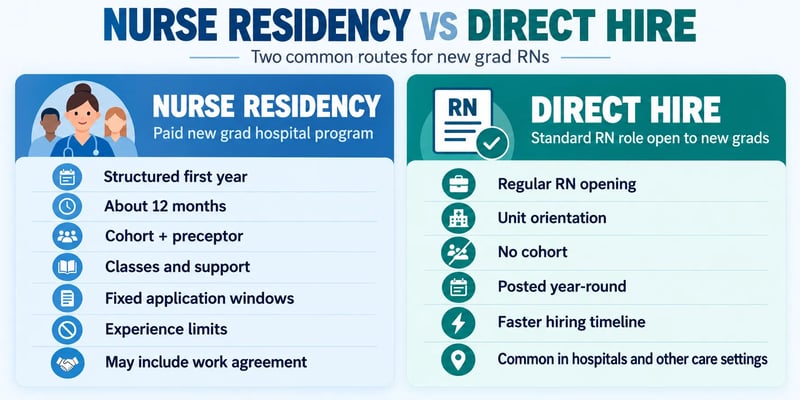
New grad RN jobs in Texas come through two doors. The first is a nurse residency, a paid first year with a preceptor, classes, and a cohort of other new nurses. The second is a direct-hire new grad position, where a unit hires you into a regular RN role with a standard orientation. Both sit on the first rung of the nursing career ladder for licensed nurses, and the choice shapes your first 12 months.
Nurse Residency Programs
Residencies are the main hospital route. In the 2025 Early Career Nurses Survey, 65.7% of respondents were offered a nurse residency and 63.6% were offered a preceptorship or mentorship, with a median of 12 weeks spent with a preceptor. The programs are paid jobs from day one, most are accredited, and all are built around a cohort that starts together. Step 3 compares ten of them.
Direct-Hire New Grad Positions
Direct-hire openings matter when you miss a window or want a setting outside the big systems. Acute care hospitals employed 69.9% of early-career Texas RNs in 2025, which leaves about 30% starting elsewhere, including clinics, nursing facilities, home health, and public health. Those employers post new grad openings year-round on their own career sites and on the job boards, and they can move faster than a cohort calendar.
Step 2: Get Your Texas RN License or GN Permit Before You Apply
Timing matters because Texas residency programs set their own license rules, and an application without the right credential at the right time can be screened out. Texas Children's wants a Texas RN license before the start date, Houston Methodist accepts a GN permit, and Texas Health Resources requires boards passed before the residency starts. The Texas Board of Nursing lays out the steps, and our guide to how to become a registered nurse in Texas walks through each one.
- Apply for licensure by examination in the Texas Nurse Portal.
- Submit fingerprints for the criminal background check. IdentoGO charges $41.95.
- Register with Pearson VUE for the NCLEX-RN ($200). The Board recommends doing this at least 30 days before graduation.
- Pass the Nursing Jurisprudence Exam, which has 50 items, a 2-hour limit, and a 75% passing score, before the Board issues your Authorization to Test (ATT).
- Have your program submit the affidavit of graduation. The Board reviews the file for an ATT within 15 business days of the last item arriving.
- Pass the NCLEX-RN. The permanent license is issued within 15 business days after the Board receives a passing result.
The GN Permit: Working Before You Pass the NCLEX
The graduate nurse (GN) permit decides whether you can start before your results come in. New graduates who have never taken the NCLEX, have registered for it, submitted fingerprints, and passed the jurisprudence exam can work as a GN. The permit posts in the Nurse Portal within 5 business days of the ATT email, lasts 75 days, and cannot be extended. It ends early when you receive your permanent license or a failing result.
The limits come from 22 TAC 217.3, the Board rule on temporary authorization. A GN works under the direct supervision of a registered nurse who is physically present in the facility and on the same unit. A GN cannot be placed in supervisory or charge positions, and after a failing notice must tell employers and stop practicing right away. Our graduate nurse in Texas guide covers the permit period and what to do if the first attempt does not go your way.
Step 3: Apply to Texas Nurse Residency Programs
A nurse residency in Texas is a paid, structured transition program for newly licensed RNs, usually about 12 months, with a preceptor, classes, and a cohort. The ten programs below cover the major Houston and Dallas-Fort Worth systems plus one statewide program, with the rules that decide whether you can apply. Dates are as of October 23, 2026, and every program changes them each cycle, so confirm the window on the program page before you plan around it.
Houston programs, where the Texas Medical Center anchors new grad nurse residency programs:
Dallas-Fort Worth programs, where nurse residency Dallas searches cover five systems:
Statewide:
If you are weighing the best nurse residency programs in Texas, accreditation is the most objective signal. Texas Children's and UT Southwestern hold ANCC Practice Transition accreditation, Baylor Scott & White and MD Anderson hold it with distinction, and Memorial Hermann cites ANCC accreditation. Medical City displays the ANCC mark, and Houston Methodist, Children's Health, and VA North Texas are accredited by CCNE. Texas Health Resources does not state an accreditation on its residency page.
How to Apply Without Missing a Window
- Build a calendar from each program page. Windows can be short, and Memorial Hermann's Summer 2027 external window runs five days.
- Line up documents early: a resume, transcripts, an American Heart Association BLS card, and for Texas Health Resources a one-to-two-page essay about a meaningful clinical situation. Texas Children's adds a 500-word personal mission statement and a clinical instructor recommendation.
- Meet the GPA floors. Memorial Hermann, UT Southwestern, and VA North Texas require a 3.0, and Houston Methodist prefers one.
- Check the experience limit before you take a first job elsewhere, because it runs from under 6 months at Houston Methodist and Medical City to under 1 year at most others.
- Read the work agreement. Texas Health Resources asks for 15 months in the entity and specialty you were hired into.
- Apply to programs in more than one metro in the same cycle.
Step 4: Search Houston, Dallas-Fort Worth, and the Rest of Texas
Residencies are only part of the market, and Texas hospitals are still short of nurses. The RN vacancy rate in Texas hospitals was 16.4% in 2024, and the median RN turnover rate was 23.2%, according to the Texas Center for Nursing Workforce Studies. Looking further out, Texas projects a shortfall of 56,370 full-time RNs by 2036, meaning 15.6% of demand would go unmet.
Where you search changes both the openings and the pay. The lowest-paid 10% of RNs, the closest public measure of starting pay, earn the most in Killeen-Temple ($75,130), Houston ($74,860), Austin ($73,440), and Dallas-Fort Worth ($73,400), against $66,430 in San Antonio (BLS, May 2025).
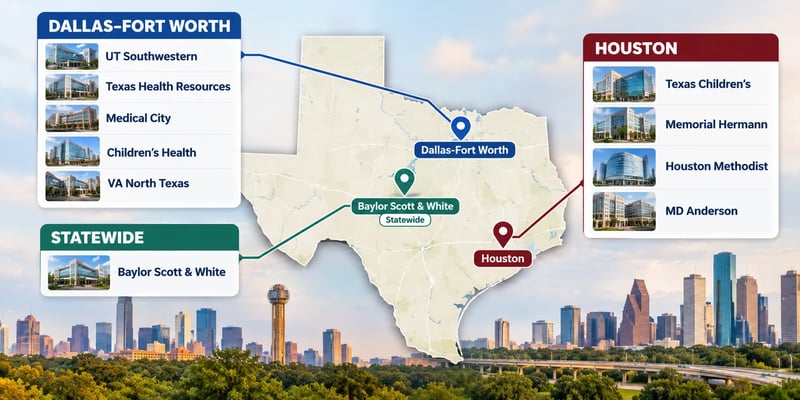
- Houston: new grad RN jobs in Houston cluster around the Texas Medical Center, home to four of the residency programs in Step 3 (Texas Children's, Memorial Hermann, Houston Methodist, MD Anderson).
- Dallas-Fort Worth: new grad RN jobs in Dallas span five programs (UT Southwestern, Texas Health Resources, Medical City, Children's Health, VA North Texas), and Medical City alone runs 22 hospitals.
- San Antonio, Austin, and the rest of Texas: search health system career sites directly, use Baylor Scott & White's statewide program, and watch rural hospital districts, which post direct-hire new grad openings, some with sign-on bonuses.
Where to Search
- Hospital career sites and the residency pages in Step 3, with job alerts turned on wherever the site offers them.
- WorkInTexas.com, the Texas Workforce Commission's job matching site, where job seekers register for a free account.
- Nursing facilities, home health agencies, and clinics, which hire new grad RNs outside the cohort calendar.
- One job board such as Indeed for alerts, with applications sent through the employer's own site when possible.
Step 5: Stand Out as a New Grad in Texas
Getting hired as a new grad RN in Texas comes down to three things: apply inside the windows, hold the credential the program asks for by its deadline, and show you can think clinically. Texas hospitals name a lack of critical thinking skills (29.2%) and a lack of clinical experience or skills (27.4%) as the top preparation gaps in new nurses (Texas Center for Nursing Workforce Studies, 2024 Hospital Nurse Staffing Survey).
- Treat clinical rotations and your capstone preceptorship as a working interview, and ask your preceptor for a reference.
- Work in a patient-care role during school. The clinical hours are what hiring managers look for.
- Keep an American Heart Association BLS card current. Several Texas programs require it at application.
- Be flexible on location. Job location was the top reason early-career Texas nurses took their first job (58.2%), so a wider radius means more options.
- If you hold an ADN, target Memorial Hermann, Texas Health Resources, and Houston Methodist Baytown, and plan a BSN if you want programs that require one (Texas Children's, UT Southwestern, Children's Health, VA North Texas).
- Plan past year one. 55.8% of nurses licensed 3 to 5 years had left their first employer (TCNWS, 2025), so a first job is a starting point, not a lifetime choice.